
Why Are We Still Moving Index Cards Around?
INT. COFFEE SHOP - DAY · 2026-09-10
The Writer's Gripes — Part Two
FADE IN:
INT. WRITER'S OFFICE - DAY
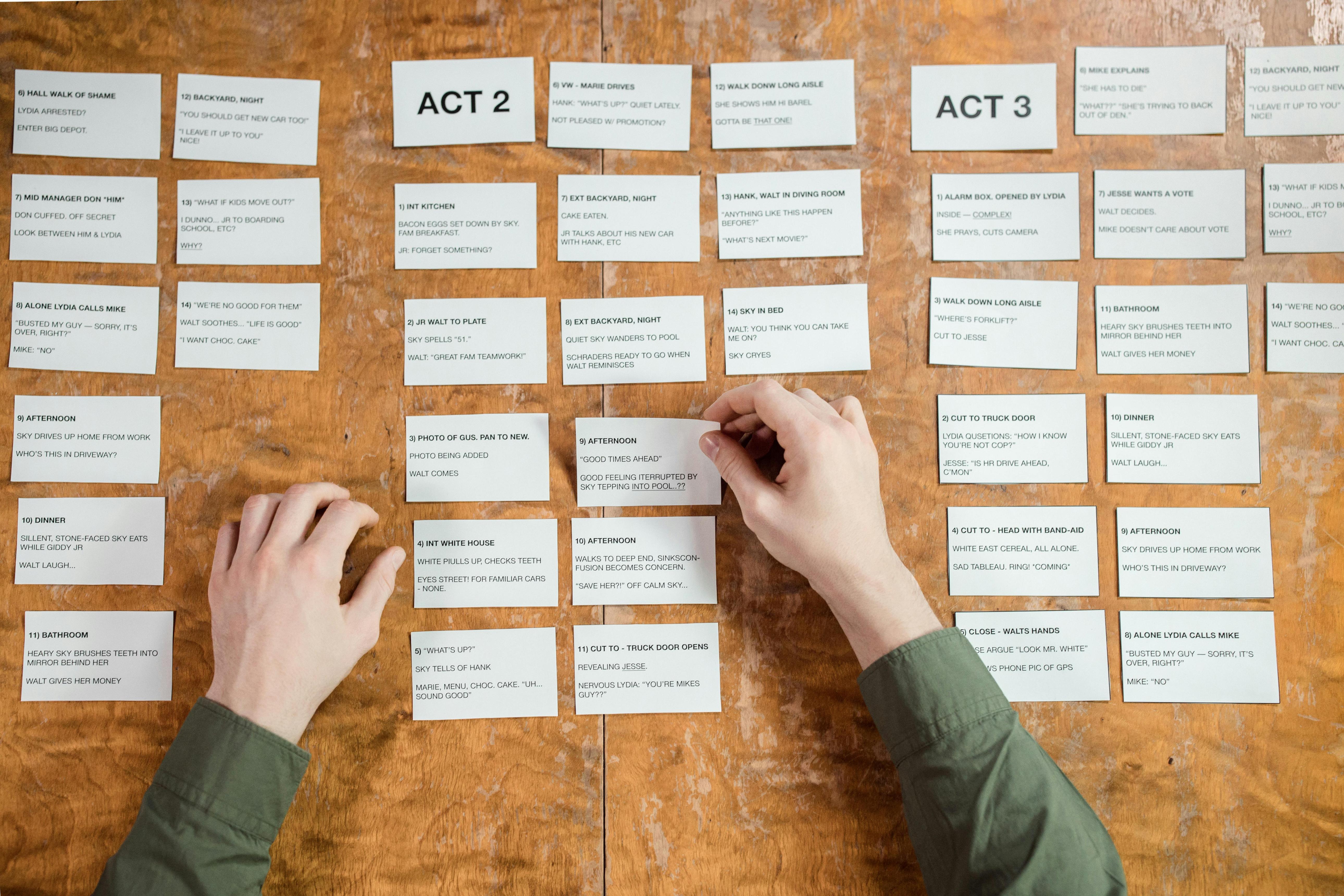
A screenwriter stands in front of a wall covered in colourful index cards.
They move one card from Act Two to Act Three.
Then another.
Then six more.
They stare at the wall.
Something isn't right.
They move the first card back.
CUT TO:
INT. WRITER'S OFFICE - NIGHT
The screenwriter is still moving cards.
The screenplay remains untouched.
FADE OUT.
There's something wonderfully satisfying about a wall covered in index cards.
You can see your entire story at once. Move scenes around. Spot holes in the plot. Realise that the character who disappeared on page 37 probably ought to make another appearance before the credits roll.
It's a fantastic way to work.
Until you realise you've spent three hours organising your story and haven't written a single word.
And believe me, I know how easy it is to convince yourself that moving a few cards around counts as a productive writing session.
Technically, it does.
But at some point, somebody has to write the screenplay.
The Problem Isn't the Cards
Index cards have been part of screenwriting for decades, and for good reason.
They're simple. Visual. Flexible.
You can scribble on them, rearrange them, throw them away, or stare at them until inspiration arrives.
I've always liked the idea of being able to see a story laid out in front of me. There's something reassuring about knowing where everything is supposed to happen.
Even if the characters occasionally have other ideas.
And I'm certainly not suggesting that physical index cards have had their day.
If a wall covered in cards works for you, brilliant.
Keep the wall.
Digital scene boards try to capture that same freedom, and many do a good job of it.
But sometimes digital planning creates a new problem.
You write an outline. Then you write the screenplay. Then you update the outline because the screenplay changed. Then you rearrange the cards because the outline changed.
Suddenly you're maintaining three different versions of the same story.
And let's be honest, keeping track of one version is difficult enough.
I've found that one of the frustrations of planning a screenplay digitally is the amount of time you can spend managing the planning itself.
A scene changes in the script, but the outline still describes the old version.
A character disappears from a sequence, but they're still mentioned on a card somewhere.
You move a scene, forget to update something else, and before long you're wondering which version of the story you're supposed to be following.
At that point, the software isn't necessarily helping you write.
It's giving you another job.
And I've already got enough of those.
A Scene Is a Scene
When I started developing INT. COFFEE SHOP - DAY and its screenplay editor, ICDX, I wanted to think about how planning and writing could work together rather than feeling like two separate activities.
To me, a scene is a scene.
Whether I'm looking at it as a card on a board or as formatted pages in a screenplay, it's still part of the same story.
That's the thinking behind the scene-card workflow I'm developing for ICDX.
My aim is straightforward: the scene board should reflect the screenplay you're actually writing.
If I change a scene in the script, I don't want to spend another twenty minutes updating a separate planning document.
If I rearrange the story, I want to be able to see how those changes affect the screenplay.
And if I decide that the entire second act belongs in the bin — which, as a screenwriter, is always a possibility — I'd like the software to help me experiment without creating an almighty mess.
I'm working towards a scene board that connects planning directly to the screenplay, with visual organisation, easy rearranging and useful scene information.
The idea is to make it easier to see the shape of a story, identify where things aren't working and try different approaches.
Not because physical index cards are outdated.
They're not.
And not because I think I've discovered some revolutionary new way to structure a screenplay.
I haven't.
I'm simply trying to make the tools work together in a way that feels natural to me as a writer.
Because if a computer can remember all the complicated bits, I'd quite like to leave my brain free to concentrate on the story.
It's already busy trying to remember why I walked into the kitchen.
Keep the Creative Mess. Lose the Unnecessary Work.
Every writer has a different process.
Some outline every scene before typing FADE IN.
Others start with a character, a situation and absolutely no idea what happens next.
Some use elaborate colour-coded systems.
Others have a notebook containing three illegible sentences and a coffee stain.
All perfectly valid.
Personally, I don't believe there's one correct way to write a screenplay.
There are methods, techniques and approaches that can help, certainly.
But ultimately, every writer has to find a process that works for them.
And sometimes that process changes from one project to the next.
One screenplay might demand a carefully constructed outline.
Another might begin with a single scene that won't leave you alone.
I've never wanted ICDX to dictate how somebody should write.
Quite the opposite.
I want to build tools that adapt to the writer, rather than expecting the writer to adapt to the software.
If you love planning every beat, I want ICDX to help you do that.
If you prefer discovering the story as you write, I want it to stay out of your way.
And if you start with a beautifully organised scene board only to abandon the entire thing halfway through Act Two, well, that's screenwriting.
I've been there.
The point isn't to eliminate the creative chaos.
Some of the best ideas come from it.
The point is to get rid of the unnecessary work that surrounds it.
Because writing a screenplay is difficult enough without spending half your day making sure your outline, scene cards and script all agree with one another.
And if I can make that process a little easier, I'll be happy.
After all, the best planning system is the one that helps you finish your screenplay.
Not the one that gives you another excuse to avoid it.
Although, if I'm being completely fair, screenwriters have never needed much help finding those.
FADE OUT.
Different tools. Same blank page. We're all writers here.
Steve
Developer, Screenwriter and Founder of INT. COFFEE SHOP - DAY